높은통과율TM3인증시험공부자료인기덤프문제다운
Wiki Article
참고: ITDumpsKR에서 Google Drive로 공유하는 무료 2026 BCS TM3 시험 문제집이 있습니다: https://drive.google.com/open?id=1Z0lvrfNVf-uNba4KCE1iDgEK-9P5bC-0
ITDumpsKR의BCS TM3 인증시험덤프는 자주 업데이트 되고, 오래 되고 더 이상 사용 하지 않는 문제들은 바로 삭제해버리며 새로운 최신 문제들을 추가 합니다. 이는 응시자가 확실하고도 빠르게BCS TM3덤프를 마스터하고BCS TM3시험을 패스할수 있도록 하는 또 하나의 보장입니다. 매력만점BCS TM3덤프 강력 추천합니다.
BCS TM3 시험요강:
| 주제 | 소개 |
|---|---|
| 주제 1 |
|
| 주제 2 |
|
| 주제 3 |
|
TM3인기자격증 시험대비자료 & TM3시험난이도
BCS업계에 종사하시는 분들은 TM3인증시험을 통한 자격증취득의 중요성을 알고 계실것입니다. ITDumpsKR에서 제공해드리는 인증시험대비 고품질 덤프자료는 제일 착한 가격으로 여러분께 다가갑니다. ITDumpsKR덤프는 TM3인증시험에 대비하여 제작된것으로서 높은 적중율을 자랑하고 있습니다.덤프를 구입하시면 일년무료 업데이트서비스, 시험불합격시 덤프비용환불 등 퍼펙트한 서비스도 받을수 있습니다.
최신 Test Manager TM3 무료샘플문제 (Q10-Q15):
질문 # 10
The diagram below shows an incomplete defect management process, where three states (states X, Y and Z) have yet to be named appropriately.
Which of the following labels would correctly complete the process?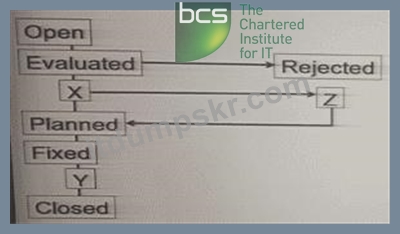
- A. X: In Progress, Y: Verified, Z: Terminated.
- B. X: Accepted, Y: Tested, Z: Deferred.
- C. X: Accepted, Y: Reviewed, Z: Duplicate.
- D. X: Approved, Y: Reviewed, Z: Deferred.
정답:B
설명:
According to theISTQB Certified Tester Advanced Level - Test Manager v3.0 syllabus (Chapter 2: Test Management in the Organization), thedefect management processdefines how defects are handled from discovery to closure, ensuring traceability and communication between testing and development.
"The defect management process defines the states a defect may have during its lifetime, including identification, evaluation, correction, re-testing (confirmation testing), and closure." (ISTQB CTAL-TM v3.0 Syllabus, Chapter 2 - Defect Management Process) In the standard ISTQB defect workflow:
Afterevaluation, a defect can either be:
Rejected(e.g., not a defect, duplicate, or out of scope), or
Accepted(X) - meaning it is confirmed as a valid defect and will be corrected.
Once accepted, the defect isplannedfor correction andfixedby development.
After being fixed, it must betested (Y)- also referred to asconfirmation testingorretesting.
Some evaluated defects may bedeferred (Z)- postponed for future releases.
Thus, the correct states are:
X = Accepted(defect confirmed as valid and correction planned)
Y = Tested(confirmation testing after the fix)
Z = Deferred(postponed correction)
This sequence aligns directly with the ISTQB-defineddefect management lifecycle, which includes transitions betweenopen,evaluated,accepted (planned/fixed/tested), andclosed, as well as possiblerejectedordeferredbranches.
References (from ISTQB Certified Tester Advanced Level - Test Manager v3.0 Syllabus):
Chapter 2: Test Management in the Organization
Section:Defect Management Process
Describes thedefect states, includingopen, evaluated, accepted, planned, fixed, tested (retested), closed, and alternate states such asrejectedordeferred.
질문 # 11
Analytical test improvement approaches identify problems based on data from the project or team.
Appropriate improvements can be derived from an analysis of the identified set of problems.
Which of the following is not an example of an analytical-based test process improvement approach?
- A. Quantitative TPI NEXT assessment
- B. The Goal Question Metric (GQM) approach
- C. Root cause analysis
- D. Analysis using measures, metrics and indicators
정답:A
설명:
Comprehensive and Detailed Explanation From Exact Extract of ISTQB Certified Tester Advanced Level - Test Manager v3.0 syllabus:
The syllabus classifies improvement approaches includinganalytical approaches(e.g.,root cause analysis, GQM, andanalysis of measures/metrics/indicators) that derive improvements byanalysing project/team data.
Model-basedapproaches (e.g.,TMMi,TPI NEXT) are a distinct category that evaluate practicesagainst a reference modelrather than primarily deriving improvements from project data analysis.
Hence,B (Quantitative TPI NEXT assessment)ismodel-based, not ananalyticalapproach;A, C, and Dare analytical.
(References: CTAL-TM v3.0 Syllabus - Chapter 2 "Test Management in the Organization" - improvement approaches: analytical vs. model-based vs. other; examples provided for each category.)
질문 # 12
You are a test manager developing a master test plan. As part of the master test plan, you are defining exit criteria for the various test levels.
Which of the following exit criteria would be most appropriate and SMART for component testing, and which one would be most appropriate and SMART for system testing?
i. 95% of the tests prepared are executed successfully
ii. All test cases have been run
iii. 80% decision coverage for all tests run
iv. At least 30 defects have been found
v. At least two weeks of test execution
vi. No more open defects
- A. iii for component testing, v for system testing
- B. v for component testing, vi for system testing
- C. iii for component testing, i for system testing
- D. ii for component testing, iv for system testing
정답:C
설명:
Comprehensive and Detailed Explanation From Exact Extract of ISTQB Certified Tester Advanced Level - Test Manager v3.0 syllabus:
The syllabus emphasizesSMART exit criteriatailored to the test level:
Forcomponent testing, structural coverage metrics (e.g.,decision coverage) are appropriate and measurable at code level, makingiii (80% decision coverage)suitable and SMART.
References: ISTQB CTAL-TM v3.0 Syllabus-Chapter 3 (Test Planning: defining level-appropriate and measurable entry/exit criteria; use of structural coverage for lower levels and outcome/behavior criteria for higher levels).
질문 # 13
In multi-team environments with hybrid software development approaches, there are various challenges in the context of defect management, such as:
i. Alignment of defect attributes to be used
ii. Prioritisation of defects
iii. Alignment of the approach for defect fixes
Solutions to the above-mentioned challenges include:
- A. A = i, B = ii, C = i
- B. A = ii, B = i, C = iii
- C. Synchronisation between the defect management tools
- D. The product owner should be involved in the defect management meetings
- E. A = i, B = iii, C = ii
- F. Transparency of plans by sharing them between teams via dashboardsWhich solution is related to which challenge?
- G. A = i, B = ii, C = iii
정답:F
설명:
Comprehensive and Detailed Explanation From Exact Extract of ISTQB Certified Tester Advanced Level - Test Manager v3.0 syllabus:
ii. Prioritisation of defects # A. Product owner involvement: The PO (or equivalent business authority) ensuresbusiness-value/risk-based prioritizationis consistent across teams.
i. Alignment of defect attributes # B. Tool synchronization: Toalign fields/attributes/statuses, teams synchronize or harmonize defect management tools and schemas.
iii. Alignment of approach for fixes # C. Transparent shared dashboards:Shared plans/dashboardssupport coordination onhow/whenfixes are implemented across teams, improving consistency and visibility.This mapping reflects the syllabus coverage oforganization-level test management, multi-team governance, tool alignment, and cross-team transparency practices in hybrid/Agile environments (CTAL-TM v3.0, Chapter 2:
Test Management in the Organization; Chapter 5: defect management coordination and reporting).
질문 # 14
A project has been running for a few months and the team does not seem to be making progress in their test approach. The team also lacks drive and enthusiasm and is sometimes seen to be performing their tasks too slowly. You have been asked to recruit an extra person into the team. In addition to introducing the new team member, you have decided to raise motivation.
Which of the actions listed below would most likely result in the opposite, a de-motivation of the team?
- A. Organising a meeting with senior management in which senior management addresses the importance of good testing for this project.
- B. Criticising testers only in private when they made a mistake during their test activities.
- C. Constantly prescribing overtime to the testers so that they will be accustomed to perform extra hours when necessary.
- D. Providing adequate rewards to the testers when they have done an outstanding job.
정답:C
설명:
Comprehensive and Detailed Explanation From Exact Extract of ISTQB Certified Tester Advanced Level - Test Manager v3.0 syllabus:
The syllabus addressesmotivators and de-motivatorsin test teams. Sustainedmandatory overtimeis explicitly highlighted as ade-motivator, leading to burnout, reduced morale, and lower quality over time. In contrast, private, constructive feedback,recognition/reward, andvisible management supportare listed as practices that canimprove motivation. Hence,constantly prescribing overtime (B)is the option most likely tode-motivatethe team.
(ISTQB CTAL-TM v3.0 - Chapter "People Skills - Team Composition": motivation and de-motivation factors; effects of overwork, recognition, supportive leadership, and constructive feedback.)
질문 # 15
......
ITDumpsKR의BCS인증 TM3덤프는 인터넷에서 검색되는BCS인증 TM3시험공부자료중 가장 출중한 시험준비 자료입니다. BCS인증 TM3덤프를 공부하면 시험패스는 물론이고 IT지식을 더 많이 쌓을수 있어 일거량득입니다.자격증을 취득하여 자신있게 승진하여 연봉협상하세요.
TM3인기자격증 시험대비자료: https://www.itdumpskr.com/TM3-exam.html
- TM3인증시험 공부자료 100%시험패스 덤프공부자료 ???? 지금▛ www.koreadumps.com ▟에서➡ TM3 ️⬅️를 검색하고 무료로 다운로드하세요TM3완벽한 인증자료
- TM3인증시험덤프 ???? TM3참고자료 ???? TM3최신 덤프샘플문제 다운 ???? ⮆ www.itdumpskr.com ⮄에서⇛ TM3 ⇚를 검색하고 무료 다운로드 받기TM3인증시험대비 공부문제
- 100% 유효한 TM3인증시험 공부자료 덤프문제 ???? 「 www.koreadumps.com 」에서《 TM3 》를 검색하고 무료로 다운로드하세요TM3시험기출문제
- TM3최신 시험대비자료 ???? TM3합격보장 가능 시험 ↗ TM3인증시험대비 공부문제 ???? 지금➡ www.itdumpskr.com ️⬅️에서✔ TM3 ️✔️를 검색하고 무료로 다운로드하세요TM3시험대비자료
- TM3시험패스 가능한 공부 ???? TM3인증시험대비 공부문제 ???? TM3합격보장 가능 공부자료 ???? 무료로 쉽게 다운로드하려면⏩ www.dumptop.com ⏪에서☀ TM3 ️☀️를 검색하세요TM3시험패스 가능한 공부
- 100% 유효한 TM3인증시험 공부자료 시험대비자료 ???? 무료 다운로드를 위해➤ TM3 ⮘를 검색하려면[ www.itdumpskr.com ]을(를) 입력하십시오TM3최신 덤프샘플문제 다운
- TM3인증시험대비 공부문제 ???? TM3시험대비 최신 덤프 ???? TM3퍼펙트 덤프데모문제 보기 ???? ☀ www.exampassdump.com ️☀️웹사이트를 열고⮆ TM3 ⮄를 검색하여 무료 다운로드TM3퍼펙트 덤프데모문제 보기
- TM3유효한 시험대비자료 ???? TM3시험대비자료 ???? TM3시험기출문제 ???? 검색만 하면➽ www.itdumpskr.com ????에서[ TM3 ]무료 다운로드TM3최신 시험대비자료
- TM3인증시험 공부자료 100%시험패스 덤프공부자료 ???? ▛ www.itdumpskr.com ▟은➡ TM3 ️⬅️무료 다운로드를 받을 수 있는 최고의 사이트입니다TM3시험대비자료
- TM3시험패스 가능한 공부 ???? TM3최신 시험대비자료 ???? TM3합격보장 가능 공부자료 ???? 지금➽ www.itdumpskr.com ????을(를) 열고 무료 다운로드를 위해▷ TM3 ◁를 검색하십시오TM3시험기출문제
- TM3합격보장 가능 시험 ???? TM3유효한 시험대비자료 ???? TM3유효한 시험대비자료 ???? 무료 다운로드를 위해▷ TM3 ◁를 검색하려면➡ www.exampassdump.com ️⬅️을(를) 입력하십시오TM3시험패스 가능한 공부
- olivebookmarks.com, murrayfphb006798.tkzblog.com, mysterybookmarks.com, www.stes.tyc.edu.tw, myportal.utt.edu.tt, myportal.utt.edu.tt, myportal.utt.edu.tt, myportal.utt.edu.tt, myportal.utt.edu.tt, myportal.utt.edu.tt, myportal.utt.edu.tt, myportal.utt.edu.tt, myportal.utt.edu.tt, myportal.utt.edu.tt, heathamvh626187.empirewiki.com, keymander2.com, orlandomfwc130991.vidublog.com, mariyahfsew246724.therainblog.com, myauzou120851.techionblog.com, Disposable vapes
그리고 ITDumpsKR TM3 시험 문제집의 전체 버전을 클라우드 저장소에서 다운로드할 수 있습니다: https://drive.google.com/open?id=1Z0lvrfNVf-uNba4KCE1iDgEK-9P5bC-0
Report this wiki page